Updated on June 10, 2026
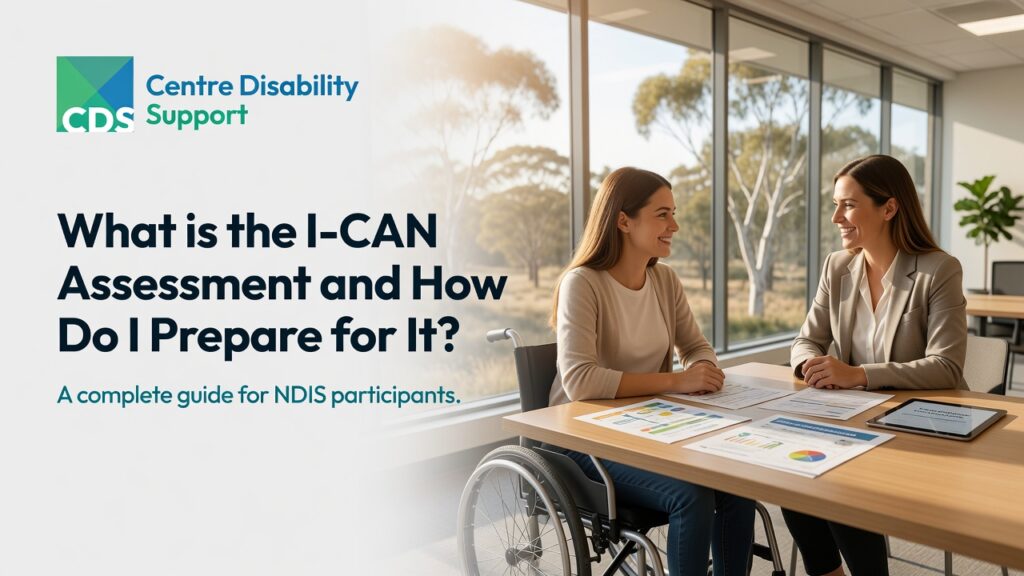
What is the I-CAN Assessment?
The I-CAN v6 is the Instrument for Classification and Assessment of Support Needs, version 6—a comprehensive, person-centred assessment tool that the NDIS has selected as the foundation for its new framework planning approach. Developed by the University of Melbourne and the Centre for Disability Studies, the I-CAN has been used in Australian disability and aged care services for over two decades, though it is new to the NDIS context (Riches et al., 2009).
Unlike traditional deficit-focused assessments, the I-CAN employs a strength-based methodology grounded in the World Health Organisation’s International Classification of Functioning, Disability and Health (ICF) framework. Rather than cataloguing what a person cannot do, the I-CAN identifies what supports are needed for individuals to live meaningful, productive lives in inclusive community settings. This philosophical shift aligns with contemporary disability support paradigms that emphasise participation, autonomy, and individualised support rather than functional limitations alone.
The instrument has demonstrated robust psychometric properties across diverse disability populations. In field testing with 1,012 individuals with disabilities across eastern Australian states, the I-CAN effectively discriminated a range of support intensities and proved capable of developing comprehensive support profiles across multiple life domains. The team-based approach to administration—involving the person with disability, family members, friends, and support staff as appropriate—has proven beneficial for accurate assessment and future planning.
Why is the NDIS Introducing the I-CAN Assessment?
The current NDIS planning process has faced sustained criticism from participants, advocates, and disability organisations for several systemic issues:
Inconsistency in funding decisions: Two participants with similar support needs can receive vastly different funding allocations depending on which planner reviews their case, what evidence is submitted, and how that evidence is interpreted. This “postcode lottery” effect has undermined confidence in the scheme’s fairness.
Financial and administrative burden: The existing system requires participants to obtain multiple allied health reports from occupational therapists, psychologists, speech pathologists, and other professionals. These reports can cost hundreds or thousands of dollars, often funded from participants’ existing NDIS plans, creating a circular funding problem where support budgets are depleted by the assessment process itself.
Opacity in decision-making: Many participants report not understanding how their funding amounts were calculated or why certain supports were approved while others were declined. The lack of transparent methodology makes it difficult to advocate effectively or prepare appropriate evidence.
Rigidity in plan structure: Current plans are typically structured around specific support categories with limited flexibility to adapt to changing circumstances without triggering a full plan review.
The 2023 NDIS Review recommended fundamental reforms to address these issues, and the 2024 NDIS Act amendments provided the legislative framework for a new assessment-based planning approach. The I-CAN v6 was selected as the standardised assessment tool to underpin this new system, with the goals of improving consistency, reducing participant burden, increasing transparency, and enabling more flexible funding arrangements.
The 12 Life Domains Assessed by I-CAN
The I-CAN assessment comprehensively evaluates support needs across 12 distinct life domains, each containing multiple sub-categories. Most domains include four sub-categories, with the exception of physical health, which encompasses 10 sub-domains to capture the complexity of health-related support needs. This structure ensures that assessment covers the full spectrum of daily living, from basic self-care to complex social participation.
The 12 Domains
- Mobility: Moving around home and community, transferring between positions, using mobility equipment and aids
- Self-Care: Personal hygiene, showering, bathing, dressing, grooming, toileting, and continence management
- Communication: Expressing oneself, understanding others, engaging in conversations, using communication aids
- Relationships: Maintaining family connections, friendships, romantic relationships, and professional relationships
- Physical Health: Nutrition and eating, medication management, chronic condition management, pain management, and eight additional health-related sub-domains
- Mental Health: Emotional wellbeing, coping strategies, mental health condition management, psychological support needs
- Domestic Life: Cooking, cleaning, shopping, household maintenance, managing a home environment
- Community, Social and Civic Life: Money management, self-advocacy, community participation, accessing services, civic engagement
- Learning and Education: Skills development, training participation, formal and informal education access
- Work and Employment: Job readiness, workplace support requirements, career development, vocational training
- Major Life Areas: Housing stability, financial management, legal matters, major life transitions
- Behaviour and Safety: Behavioural support needs, risk management, safety considerations, challenging behaviour support
For each domain and sub-category, the assessment evaluates two key dimensions: the frequency of support required (scored from 0 for “never” to 5 for “continuously”) and the intensity of support needed (scored from 0 for “independent” to 5 for “pervasive support”). This dual-axis scoring system allows for nuanced differentiation between, for example, someone who needs occasional high-intensity support versus someone who needs continuous low-intensity monitoring.
How the I-CAN Assessment Process Works
The Strength-Based Approach
Central to the I-CAN methodology is the use of “I can” statements that frame support needs in terms of capabilities with appropriate assistance rather than deficits or limitations (Riches et al., 2009). For each assessed area, the assessor works with the participant to construct statements such as “I can prepare meals with prompting and supervision” or “I can manage my medication independently with a Webster pack and reminder system.” This approach maintains dignity and focuses on enabling participation rather than cataloguing impairments.
Assessment Structure
- Invitation and Scheduling: The NDIA will contact eligible participants to arrange their I-CAN assessment. Participants do not need to request the assessment—it will be offered as part of the regular planning cycle or when applying for NDIS access.
- Flexible Delivery Options: Assessments can be conducted in person at the participant’s home, at a Local Area Coordinator office, or at another comfortable location. Video call assessments are also available for participants who prefer remote participation. Importantly, the three-hour assessment can be split across multiple sessions if needed to accommodate fatigue, communication needs, or other considerations.
- Support Person Participation: Participants are encouraged to bring a support person who knows them well—this might be a family member, friend, support coordinator, advocate, or trusted support worker. The support person can help provide context, clarify information, and ensure the participant’s needs are accurately represented.
- The Guided Conversation: The trained assessor conducts a structured conversation covering each of the 12 domains. For each area, they explore what the participant can do independently, what they can do with support, what type of support is needed, and how frequently support is required. The assessor documents responses and assigns scores based on standardised criteria.
- Personal and Environmental Circumstances Questionnaire: Alongside the I-CAN, participants complete a supplementary questionnaire that captures contextual factors affecting support needs but not directly measured by the I-CAN instrument. This includes housing situation, informal support networks, cultural background, geographic location, and other environmental factors that influence support requirements.
- Data Integration and Plan Development: Following the assessment, the I-CAN data and environmental questionnaire responses are used to inform budget calculations. Critically, the NDIA has emphasised that trained NDIS staff—not automated algorithms—will review the assessment data and approve plans, maintaining human oversight in decision-making.
How I-CAN Affects Your NDIS Budget and Plan
More Consistent Funding Decisions
By applying a standardised assessment methodology across all participants, the I-CAN aims to reduce the significant variability in funding decisions that has characterised the current system. Participants with similar support needs should receive more comparable funding allocations, regardless of which planner reviews their case or which region they live in.
Increased Budget Flexibility
The new framework planning approach moves away from tightly prescribed support categories toward more flexible funding arrangements. Rather than having separate line items for specific supports, participants will have greater discretion to allocate their budget across different support types as their needs change, without requiring formal plan variations for minor adjustments.
Longer Plan Periods
To provide greater certainty and reduce the administrative burden of frequent plan reviews, the new system is designed to support longer plan periods. This means fewer reassessments and more stable, predictable funding over extended timeframes.
Reduced Assessment Costs
Unlike the current system where participants often pay hundreds or thousands of dollars for allied health reports (frequently from their existing NDIS funding), the I-CAN assessment is provided at no cost to participants. The NDIA funds the assessment process directly, removing this financial barrier.
Continued Role for Allied Health Reports
For participants with highly complex or specialised support needs, allied health reports may still be requested to supplement the I-CAN assessment. However, these will be the exception rather than the standard requirement, and the NDIA will provide clearer guidance about when such reports are necessary.
Community Concerns About Budget Changes
Disability advocacy organisations have expressed concern that the move to standardised assessment could result in budget reductions for some participants, particularly those who currently receive higher funding due to comprehensive allied health evidence. The NDIA has stated that the goal is fairer rather than lower budgets, but the actual impact on individual participants will not be known until the system is fully implemented and evaluated.
How to Prepare for Your I-CAN Assessment
Document Your Daily Support Needs
Begin maintaining a simple journal or notes document that records your support requirements across the 12 I-CAN domains. Include:
- Tasks you cannot complete independently
- Tasks you can complete with support (specify what type of support)
- How long tasks take you compared to others
- Variability in your support needs (good days versus difficult days)
- Support needs during health flare-ups, mental health episodes, or crisis periods
This documentation provides concrete examples to share during the assessment and helps ensure important support needs are not overlooked in the moment.
Clarify Your Goals
While the I-CAN focuses on support needs assessment, your NDIS plan must still connect to your goals and aspirations. Reflect on:
- What you want to achieve in the next one to three years
- Skills you want to develop or maintain
- Independence you want to build in specific areas
- Community, employment, or educational participation you want to pursue
- Relationships you want to develop or strengthen
Having clear, specific goals helps contextualise your support needs and ensures your plan enables meaningful participation rather than just meeting basic care requirements.
Maintain Current Allied Health Reports
Even though allied health reports will not be the primary evidence source, keep your existing reports from occupational therapists, psychologists, speech pathologists, and medical specialists up to date. For participants with complex needs, these may still be requested to supplement the I-CAN assessment.
Identify Your Support Person
Consider carefully who you will bring to your three-hour assessment. The ideal support person:
- Knows your daily routines and support needs intimately
- Can provide specific examples of your support requirements
- Understands your goals and aspirations
- Can advocate effectively on your behalf
- Is available for the full assessment duration (or multiple sessions if split)
This might be a family member, long-term support worker, support coordinator, or trusted friend. Discuss the assessment with them in advance so they understand what information will be helpful.
Understand Your Rights
Familiarise yourself with your ongoing rights under the NDIS, including:
- The right to request a plan reassessment if your circumstances change
- The right to request an internal review of decisions within three months
- The right to apply for external review through the Administrative Appeals Tribunal
- The right to bring a support person to all assessments and meetings
- The right to access your assessment data and understand how decisions were made
Engage Support Coordination Services
If you have support coordination funding, work with your support coordinator to prepare for the I-CAN assessment. Support coordinators can help you document your needs, prepare relevant evidence, attend the assessment with you, and advocate for appropriate funding. Centre Disability Support offers comprehensive support coordination services specifically designed to help participants navigate NDIS processes, including preparation for the new assessment system.
Community Concerns and How to Address Them
Concern: Algorithm-Driven Budget Decisions
The Issue: Many participants and advocates fear that budgets will be determined by automated algorithms based on I-CAN scores, removing human judgment and individualised consideration from planning decisions.
The Response: The NDIA has explicitly stated that trained NDIS staff—not computer systems—will review assessment data and approve plans. The I-CAN provides standardised data to inform decisions, but human planners retain decision-making authority and can consider individual circumstances.
What You Can Do: During your assessment, ensure all relevant contextual factors are documented in the environmental circumstances questionnaire. If your approved plan does not adequately reflect your needs, exercise your right to request an internal review with additional supporting evidence.
Concern: Three-Hour Time Limit
The Issue: Participants with complex communication needs, cognitive disabilities, or multiple co-occurring conditions worry that three hours is insufficient to accurately capture the full scope of their support requirements.
The Response: The assessment can be split across multiple sessions to accommodate fatigue, communication needs, and complexity. Assessors are trained to work at the participant’s pace and can schedule additional time if needed.
What You Can Do: Discuss timing and session structure with your assessor when scheduling. Bring your support person to help communicate your needs efficiently. Provide written documentation of your support needs in advance to supplement the conversation.
Concern: Loss of Individualised Consideration
The Issue: Standardised assessment may not capture unique aspects of individual situations, particularly for people with rare conditions, complex trauma histories, or culturally specific support needs.
The Response: The environmental circumstances questionnaire is designed to capture contextual factors not measured by the I-CAN instrument itself. Allied health reports can still be requested for complex cases. The assessment is conducted as a conversation, not a rigid checklist, allowing for individualised discussion.
What You Can Do: Prepare specific examples that illustrate your unique support needs. Bring recent allied health reports that document specialised requirements. Ensure your support person can articulate what makes your situation distinctive.
Concern: Budget Reductions
The Issue: Participants currently receiving higher funding levels fear that standardised assessment will result in reduced budgets, particularly if their current funding was based on comprehensive allied health evidence.
The Response: The NDIA’s stated goal is fairer and more consistent funding, not across-the-board reductions. However, the actual impact on individual participants will vary and cannot be predicted until the system is operational.
What You Can Do: Document your current support usage thoroughly. If your new plan provides insufficient funding, request an internal review immediately and provide evidence of your support needs and the consequences of inadequate funding. Engage an advocate or support coordinator to assist with the review process.
Concern: Cultural Appropriateness
The Issue: Aboriginal and Torres Strait Islander participants, culturally and linguistically diverse (CALD) communities, and people with lived experience of trauma have raised concerns about whether the I-CAN assessment is culturally safe and trauma-informed.
The Response: The NDIA has committed to cultural competency training for assessors and is conducting consultation with diverse communities during the implementation phase. Participants can request assessors with specific cultural knowledge or language skills.
What You Can Do: Request an assessor with appropriate cultural background or language skills when scheduling your assessment. Bring a cultural support person or interpreter. Clearly communicate any cultural considerations that affect your support needs or how you engage with services.
Timeline for I-CAN Rollout
The implementation of I-CAN and the new framework planning approach will occur gradually over several years, with careful monitoring and adjustment based on participant experiences and outcomes.
Current Status (Mid-2026)
The NDIA is currently in the consultation and testing phase. Public consultation on the new framework planning rules closed in March 2026, and the NDIA is conducting workshops through its New Framework Planning Pool to test and refine the assessment process with volunteer participants.
Initial Rollout (Mid-2026 Onwards)
The I-CAN assessment will begin rolling out from mid-2026 with a small cohort of participants aged 18 and over. This initial phase will focus on adults with intellectual disability and psychosocial disability to test the system in practice and identify any necessary adjustments.
Phased Expansion (2026-2028 and Beyond)
Following the initial rollout, the I-CAN assessment will be gradually expanded to include more participants across different disability types and age groups. The expansion will be phased over several years, meaning many current participants will not transition to the new system immediately.
Children Under 18
Children and young people under 18 are not included in the initial I-CAN rollout. The NDIA has not yet announced a timeline for when or how the new assessment approach will be adapted for children. Separate reforms to NDIS access for children under 8 are proceeding on a different timeline.
What This Means for You
If you are a current NDIS participant, your existing plan remains in place until you are scheduled for an I-CAN assessment as part of your regular planning cycle. You do not need to take any immediate action. The NDIA will contact you well in advance when it is time for your assessment, providing information about what to expect and how to prepare.
If you are applying for NDIS access for the first time, you may be assessed using either the current system or the new I-CAN approach, depending on when your application is processed and whether you are in an initial rollout cohort.
What to Do If You Disagree with the Assessment Outcome
The introduction of I-CAN does not change your fundamental rights to review and appeal NDIS decisions. If you believe your I-CAN assessment did not accurately capture your support needs or your resulting plan is inadequate, you have several options.
Request for Internal Review
If you disagree with a decision about your plan, you can request an internal review by the NDIA within three months of receiving the decision. The internal review is conducted by a different NDIA staff member who was not involved in the original decision. You can provide additional evidence, such as:
- Allied health reports that document your support needs
- Evidence of how your current supports are being used
- Documentation of support needs that were not adequately captured in the I-CAN assessment
- Statements from family members, support workers, or other people who know your daily support requirements
Centre Disability Support can assist you in preparing internal review requests, gathering supporting evidence, and articulating why the original decision was inadequate.
External Review by the Administrative Appeals Tribunal
If the internal review does not resolve your concerns, you can apply for external review by the Administrative Appeals Tribunal (AAT). The AAT is an independent body that reviews government decisions. AAT review is free, and you can represent yourself or engage a lawyer or advocate to assist you.
The AAT can affirm the NDIA’s decision, vary it, or set it aside and substitute a different decision. AAT review typically takes several months, but you can request an urgent hearing if your circumstances require immediate resolution.
Request for Plan Reassessment
If your circumstances change significantly after your I-CAN assessment—for example, your health deteriorates, you experience a major life transition, or your informal supports are no longer available—you can request a plan reassessment at any time. You do not need to wait until your scheduled plan review date.
When requesting reassessment, provide clear evidence of what has changed and how this affects your support needs. Allied health reports, medical documentation, and statements from support workers can strengthen your request.
Advocacy Support
Navigating NDIS review processes can be complex and stressful, particularly when you are simultaneously managing disability-related challenges. Engaging professional advocacy support can significantly improve your chances of a successful outcome. Centre Disability Support provides expert advocacy and support coordination services to help participants through internal reviews, AAT appeals, and reassessment requests.
How Centre Disability Support Can Help
Centre Disability Support is a registered NDIS provider offering comprehensive support services across Brisbane, Perth, Melbourne, Sydney, Gold Coast, Rockhampton, Gladstone, Townsville, and Toowoomba. As the NDIS transitions to the I-CAN assessment system, we are here to support you through every stage of the process.
Get in Touch
If you have questions about the I-CAN assessment, need help preparing for your assessment, or want to discuss how our services can support you, we are here to help.
- Phone: 1300 433 661
- Email: [email protected]
- Locations: Brisbane, Perth, Melbourne, Sydney, Gold Coast, Rockhampton, Gladstone, Townsville, Toowoomba
Visit our website to learn more about our services, make a referral, or book a consultation. Your goals matter, your voice matters, and your future matters—let Centre Disability Support walk alongside you through the changing NDIS landscape.
RELATED ARTICLES
Am I Eligible for the NDIS? The Complete 2026 Eligibility Checklist
References
Riches, V. C., Parmenter, T. R., Llewellyn, G., Hindmarsh, G., & Chan, J. (2009). I-CAN: A new instrument to classify support needs for people with disability: Part I. Journal of Applied Research in Intellectual Disabilities, 22(4), 326-339. https://doi.org/10.1111/j.1468-3148.2008.00466.x
Disclaimer: This article is for informational purposes only and does not constitute legal, medical, or financial advice. Information is current as of June 2026. The I-CAN assessment and new framework planning are still being implemented, and details may change. Always refer to the official NDIS website (www.ndis.gov.au) for the most current information.