
Updated on June 11, 2026
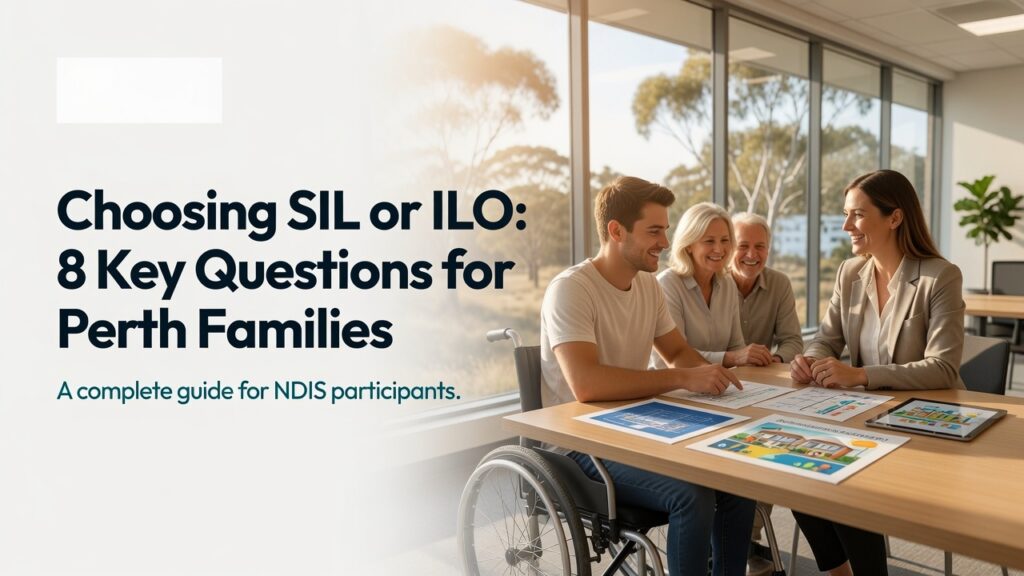
For Perth families supporting a loved one with disability, choosing where and how they will live is one of the most significant decisions they’ll make. The National Disability Insurance Scheme (NDIS) offers two primary pathways: Supported Independent Living (SIL) and Independent Living Options (ILO). This choice shapes daily routines, safety, long-term independence, community connection, and quality of life.
Perth’s NDIS community has grown significantly since Western Australia became the last state to fully transition to the NDIS in 2020. Today, thousands of WA families navigate this complex housing landscape, often feeling overwhelmed by bureaucratic processes. Research shows that housing decisions significantly impact family wellbeing, with the mental and emotional toll of navigating these transitions often underestimated (Walker et al., 2025).
This article provides Perth families with eight essential questions to guide this decision.
SIL vs ILO in Plain Language
Supported Independent Living (SIL) is NDIS funding for support workers to assist you 24 hours a day, 7 days a week. SIL is designed for people with high support needs who require active disability support for more than 8 hours per day, plus some level of supervision for the remaining hours. Support workers help with personal care, meal preparation, household tasks, and skill development. SIL typically involves living in a shared home with other NDIS participants.
Independent Living Options (ILO) is a flexible, participant-designed model for people wanting more independence. ILO is typically suited to people with low to medium support needs who want to design their own living situation. In Western Australia, ILO is particularly strong, with four established models: host arrangements (living with a non-related family), housemates (choosing your own roommates), co-residency (a support person lives in your home), and living alone (with scheduled drop-in support).
Critical distinction: You cannot hold both SIL and ILO funding simultaneously. Families must choose the option that best fits their loved one’s current support needs and independence goals, though transitions between models are possible.
Why These 8 Questions Matter
Research consistently shows that successful housing transitions depend on careful, person-centred planning that addresses specific needs and preferences (Bailey et al., 2023). Families who ask the right questions upfront are better positioned to secure arrangements that foster wellbeing, social connections, and skill development (Riches et al., 2025).
Many Perth families report feeling underprepared for this decision. The NDIS planning process can be exclusionarily complex, with inconsistent decision-making and lengthy approval timelines creating additional stress (Crowe et al., 2024). These eight questions provide a practical roadmap for effective advocacy.
The 8 Key Questions
Q1: What Level of Support Does My Family Member Need Each Day?
This foundational question often determines whether SIL or ILO is appropriate. SIL is designed for people who need active disability support for more than 8 hours per day plus some level of supervision for the remaining hours (24/7 coverage). ILO is typically suited for people who need less than 24-hour support and can manage some daily activities independently or with scheduled assistance.
An occupational therapist (OT) assessment is essential for SIL applications, documenting functional capacity and support requirements. For ILO, the exploration stage (Stage 1) helps determine appropriate support levels. Research indicates that individuals in supported independent living settings report higher personal wellbeing when support levels match their actual needs.
Q2: Does My Family Member Want to Live in a Shared Home or Independently?
Housing preference should drive your decision. SIL typically involves shared homes with other NDIS participants, communal living spaces, and shared support workers. ILO offers flexibility, including host arrangements (common in WA), housemates, co-residency, or living alone.
Research shows that families increasingly seek individualised living arrangements due to benefits like increased autonomy, choice, and control (Crowe et al., 2024). However, shared SIL arrangements can provide valuable social connection. The key is ensuring the living arrangement reflects your family member’s genuine preference, not just what’s readily available (Bailey et al., 2023).
Q3: What Are My Family Member’s Goals for Independence and Skill-Building?
Both models aim to build independence differently. SIL builds skills within a structured framework, with support workers actively teaching daily living skills. ILO maximises self-direction, with participants having greater control over daily decisions and support designed around existing capabilities.
Research emphasises that person-centred planning and authentic choice are critical for quality support outcomes (Bailey et al., 2023). Work with your family member to articulate their goals: Do they want to learn to cook independently? Manage their own schedule? Choose their own support workers? These goals should directly inform which model you pursue.
Q4: Is the Provider Registered with the NDIS Quality and Safeguards Commission?
From 1 July 2026, NDIS registration is mandatory for all SIL and ILO providers. This is especially important in Western Australia, where historically some unregistered providers have operated. Registered providers meet national quality and safety standards, undergo regular audits, and provide participants with access to formal complaint mechanisms.
Verify registration status through the NDIS Commission website. Research highlights that workforce capacity to manage complex needs and trauma-informed practices are essential for quality outcomes (David et al., 2024).
Q5: What Does the Roster of Care or ILO Service Proposal Look Like?
For SIL: An OT conducts a support needs assessment, your chosen provider prepares a detailed quote based on this assessment, and the quote is submitted to the NDIA for approval. SIL is NDIS-managed—you cannot self-manage or plan-manage this funding.
For ILO: Stage 1 (Exploration and Design) involves 30, 50, or up to 100 hours for a provider to work with your family member to design their ideal living arrangement. The provider prepares a Service Proposal. Stage 2 (Implementation): Once approved, ongoing funding is allocated in one of three bands based on support complexity (Band 1: lower needs; Band 2: moderate needs; Band 3: complex needs).
Ask providers to show you sample rosters or service proposals. Quality providers will clearly explain how support hours are allocated and how flexibility is built into the arrangement.
Q6: What Is the Provider’s Track Record in Perth and WA Communities?
Local knowledge matters significantly. Consider geographic coverage across Perth metro suburbs, local connections with community organisations, cultural competence (including support for Aboriginal and Torres Strait Islander participants), and WA-specific experience with ILO models, particularly host arrangements common in this state.
Perth suburbs with strong SIL and ILO availability include Karrinyup, Kelmscott, Wellard, Subiaco, Cockburn, Armadale, Bayswater, and Belmont. However, WA’s geographic isolation means provider networks may be more limited than in eastern states. Ask providers for references from other Perth families and inquire about staff retention rates.
Q7: How Will Housemate Compatibility or ILO Living Arrangement Suitability Be Assessed?
Success depends heavily on compatibility. For SIL, quality providers conduct thorough compatibility assessments before placing participants together, considering communication styles, daily routines, interests, sensory needs, and behavioural support requirements.
For ILO, host families undergo comprehensive screening, including background checks and home assessments. Providers assess the host’s capacity to provide appropriate support. Research shows that families play a key role in identifying quality support and managing teams (Carey et al., 2025). Don’t hesitate to be actively involved in compatibility assessments.
Q8: What Happens If the Arrangement Doesn’t Work Out?
Understanding exit processes upfront is essential. For SIL provider changes, you have the right to change providers, but the new provider must prepare and submit a new support needs quote to the NDIA. Review exit clauses in your service agreement before signing.
For ILO, arrangements can be adjusted if needs or circumstances change, which may require a revised Service Proposal and NDIA approval. You can also transition from ILO to SIL (or vice versa) if your support needs change significantly.
You have the right to request a plan review at any time and can lodge complaints with the NDIS Quality and Safeguards Commission if providers fail to meet standards. Research indicates that barriers to effective transitions include difficulty finding suitable housing, extended NDIS waiting times, and poor collaboration between services (Carey et al., 2025).
Perth-Specific Context
- Strong ILO culture in WA: Western Australia has embraced ILO more enthusiastically than some other states, with well-established host arrangement networks and strong community support for individualised models. This means Perth families often have more ILO options than families in other capital cities.
- Geographic considerations: Perth’s sprawling metro area and WA’s vast regional distances create logistical challenges. Provider coverage varies significantly by suburb, and families in outer metro or regional areas may have fewer options.
- NDIS transition context: WA was the last state to join the NDIS in 2020, meaning the local market is still maturing. Some providers are highly experienced; others are newer to the NDIS framework, making due diligence even more important.
- Aboriginal and Torres Strait Islander considerations: Perth has significant Aboriginal communities, and culturally appropriate support is essential. Seek providers with demonstrated cultural competence and connections to Aboriginal community organisations.
Timeline Realities and Red Flags
Timeline Realities: Start Early
The Perth SIL process can take several months from initial planning to move-in. This includes OT assessment (2-6 weeks), provider selection and quoting (4-8 weeks), NDIA approval (4-12 weeks), finding suitable housing (variable), and move-in preparation (2-4 weeks). ILO timelines vary depending on the complexity of the arrangement, but Stage 1 exploration alone can take several months.
Practical advice: Start the process at least 6-12 months before your desired move-in date. Engage a support coordinator early to help navigate the system and reduce delays.
Red Flags to Watch For
Be cautious of Perth SIL or ILO providers who:
- Cannot provide current NDIS registration details
- Rush you through decision-making or pressure you to sign agreements quickly
- Are vague about staffing, rosters, or support hours
- Have no local references or refuse to provide them
- Cannot articulate clear processes for handling complaints or emergencies
- Suggest that registration “isn’t necessary” or that they’re “exempt”
- Show limited understanding of WA-specific ILO models
- Cannot explain how they ensure cultural safety for Aboriginal participants
- Have high staff turnover or cannot provide continuity of care
- Are unwilling to involve you in compatibility assessments or planning
Trust your instincts. If something feels wrong, seek a second opinion or consult an independent advocate before proceeding.
How Centre Disability Support Can Help
Choosing between SIL and ILO is complex, but you don’t have to navigate it alone. Centre Disability Support is a registered NDIS provider offering both SIL and ILO services in Perth and nationally across Brisbane, Melbourne, Sydney, Gold Coast, Rockhampton, Gladstone, Townsville, and Toowoomba.
Contact Us
- Phone: 1300 433 661
- Email: [email protected]
RELATED ARTICLES
Choosing SIL or ILO: 8 Key Questions for Logan and Ipswich Families
What is Individual Living Options (ILO) and How is it Different from SIL?
Finding the Right SIL Home in Ipswich, QLD: A Step-by-Step Checklist
Finding the Right SIL Home in Logan, QLD: A Step-by-Step Checklist
How SIL Adapts To Individual Needs and The July 2026 Regulatory Change
SIL Readiness Checklist for Families and Participants
How to Apply for ILO Under the NDIS
How to Apply for SIL Under the NDIS
References
- Bailey, C., Iacono, T., Bould, E., Basser, L., & Douglas, J. (2023). Building person-centred homes: A case study of a cluster-designed home for adults with intellectual disability in Australia. Journal of Housing and the Built Environment, 38(4), 2357–2377. https://doi.org/10.1007/s10901-023-10050-0
- Carey, G., Malbon, E., Olney, S., & Reeders, D. (2025). “It’s going to be huge”: Family member experiences of the transition into individualised housing for people with disability. Disability and Rehabilitation, 47(3), 456–465. https://doi.org/10.1080/09638288.2025.2469767
- Crowe, A., Soldatic, K., & Spurway, K. (2024). Specialist Disability Accommodation in the social housing sector: Policy and practice (AHURI Final Report No. 412). Australian Housing and Urban Research Institute. https://doi.org/10.18408/ahuri8129801
- David, C., Muir, K., Laragy, C., Carey, G., Malbon, E., Dickinson, H., & Kavanagh, A. (2024). Experiences of people with disability living in permanent supportive housing in the context of the National Disability Insurance Scheme. Australian Journal of Social Issues, 59(2), 312–329. https://doi.org/10.1002/ajs4.378
- Riches, V. C., Parmenter, T. R., Llewellyn, G., Hindmarsh, G., & Chan, J. (2025). The relationship between personal wellbeing, choice and NDIS individualised planning and support for people with intellectual disabilities. Journal of Applied Research in Intellectual Disabilities, 38(1), e13245. https://doi.org/10.1111/jar.70085
- Walker, R., Gauntlett, L., & Dew, A. (2025). Adults with intellectual disability moving out of the family home using the National Disability Insurance Scheme: Family members’ planning experiences. Australian Journal of Social Issues, 60(1), 89–106. https://doi.org/10.1002/ajs4.70078